
From Grain to Glass: The Timing of a Craft Beer
A craft beer is not made in a day. It is made over weeks, and for almost all of that time the beer is working on its own: our craft lies in preparing each stage with precision and then respecting its timing, without rushing it.
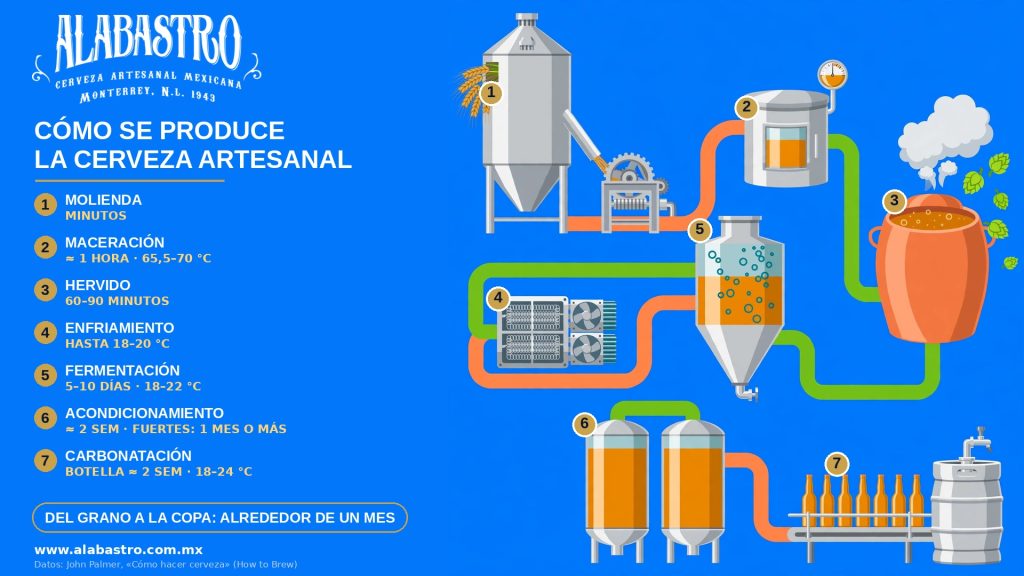
Here is the journey, stage by stage:
Milling: minutes that decide a great deal
Everything begins with milling the malt. It is not about turning it into flour: the husk is cracked and the inside of the grain exposed, so that the water can reach the starches. A good milling takes minutes, but the yield of everything that follows depends on it.
Mashing: the hour of the hourglass
The milled malt is mixed with hot water and left to rest for about an hour. In single infusion — a single temperature, the most common method — the mash is held between 65.5 and 70 °C, depending on the style: in that hour, the enzymes convert the starches into fermentable sugars. The temperature rules the final character: towards the lower end, a more fermentable wort and a drier beer; towards the upper end, more body and residual sweetness. The other route is stepped mashing, which rises through rests of around half an hour at each temperature — a classic scheme runs from 40 to 60 to 70 °C — to favour different groups of enzymes. Then the sweet liquid — the wort — is separated from the grain, in a lautering that can take another half hour or more.
The boil: 60 to 90 minutes of character
The wort is boiled for between 60 and 90 minutes. There it is sterilised, the sugars are concentrated, and the hops go in: those added at the start give the bitterness; those at the end, the aroma. When the boil finishes, the wort is cooled as quickly as possible down to fermentation temperature, around 18–20 °C for ales: that cooling is measured in minutes, and doing it well protects all the work that went before.
Fermentation: the yeast’s week
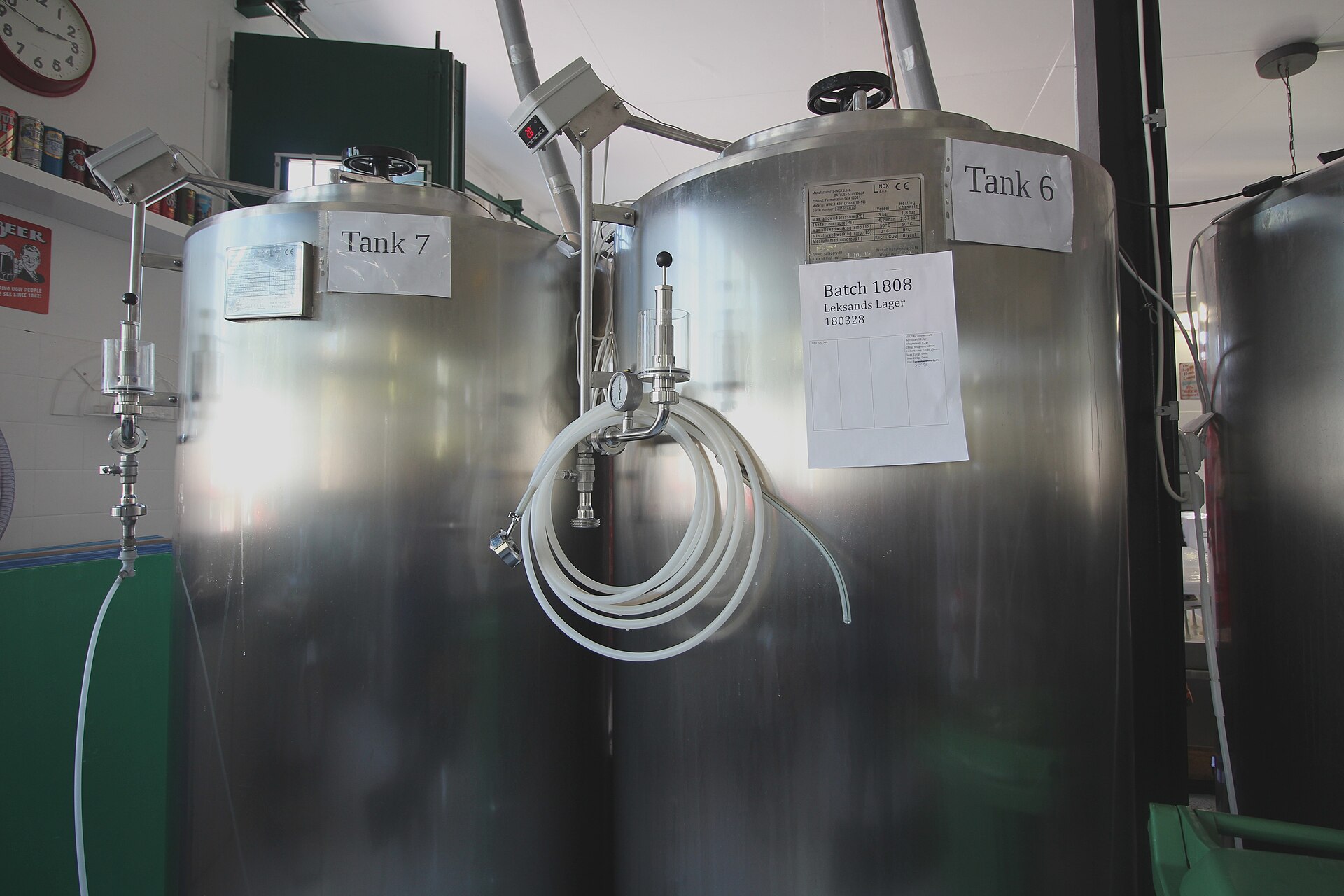
Once cool, the wort receives the yeast and the most delicate stage begins. In an ale, the main fermentation takes 5 to 10 days at 18–22 °C: the yeast consumes the sugars and produces the alcohol and the CO₂. But haste is a poor counsellor: Palmer recommends giving the beer about two weeks in the fermenter before bottling, because during the conditioning phase the yeast reprocesses the by-products of fermentation and the flavours round out. And the stronger the beer, the more time it asks for: a dark, powerful one, like an Imperial Stout, is grateful for a month or more.
Carbonation: the bubbles wait too
The last wait is for the gas, and it has two paths:
- Natural, in bottle: a small amount of sugar is added before bottling and the yeast, in a second mini-fermentation, generates the CO₂ inside the closed bottle. It takes approximately 2 weeks, with the bottles in a dark, temperate place, between 18 and 24 °C: in the first week the gas is still forming, and by the end of the two weeks the carbonation is complete and the flavour has balanced out — that conditioning period does not only add gas, it also matures the beer. If the place is very cold, the process slows down considerably.
- Forced, in keg: CO₂ is injected under pressure, cold. With the fast method it can be ready in 24 to 72 hours; with the unhurried method, in 5 to 7 days.
Carbonation is no minor detail: it is the foam, the mouthfeel and part of the aroma of every style.
Adding it all up
From milling to glass, a craft ale normally travels three to five weeks — Palmer sums it up like this: around a month after brew day, the beer is ready to taste. Most of that is not our work: it is waiting. That is why we say we respect the beer’s timing — the yeast works at its own pace, and maturation is never rushed.
If you want to see how those timings feel in the glass, come and meet the Alabastro family or write to us: the best explanation of a process is still to taste it.
Sources: John Palmer, “How to Brew” («Cómo hacer cerveza»), main reference; Lupulab, «Macerado: temperaturas, tiempos y su efecto en la cerveza»; Homebrew Talk, “How long does it generally take for a beer to carbonate in the bottle?”; Maltosaa (Instagram); cerveza-artesanal.co, «Carbonatación natural y acondicionamiento de cerveza en botellas».