
Four Raw Materials, Two Worlds: Craft Beer versus Industrial Beer
Every beer in the world — the one from the great factory and the one from the small brewery — is born of four basic raw materials: water, malt, hops and yeast. And there, in the ingredients, almost everything they have in common comes to an end. The difference lies in how each raw material is treated, in what proportions it is used, and in the brewing process.
The quartet, in brief
Water is the body: it is more than 90% of the beer. Malt provides the sugars, the colour and the flavours of bread, caramel or coffee. Hops balance with their bitterness and add perfume, as we told in the previous entry on this blog. And yeast is the living being that ferments: it converts the sugar into alcohol and gas, and leaves its signature on every style.
Where the paths divide
- The proportions and the treatment of the raw material. In craft brewing, malt is the complete base of the recipe and hops are used as flowers or pellets, with a known variety and origin; at Alabastro, what is more, we allow ourselves licences such as the hibiscus flower in our Bitter or the mango in our IPA. In large-scale industry it is common to replace part of the malt with adjuncts — rice, maize or syrups — that make the beer cheaper and lighter, and to dose the hops as extract.
- The scale. A craft batch is counted in hundreds or thousands of litres and is watched over brew by brew; an industrial batch is counted in millions of litres, and what rules is repeating the result with exactitude.
- The time. Craft fermentation and maturation are in no hurry: the yeast works at its own pace. In industry, every day in the tank costs money, and processes tend to be speeded up.
- The finish. Many craft beers are filtered little or not at all and are not pasteurised: they stay alive in the bottle. Industrial beer is filtered and pasteurised to withstand months on the shelf and long journeys.
- The variety. The small brewery lives by exploring styles; the large one, by repeating a single identical recipe in any plant in the world.
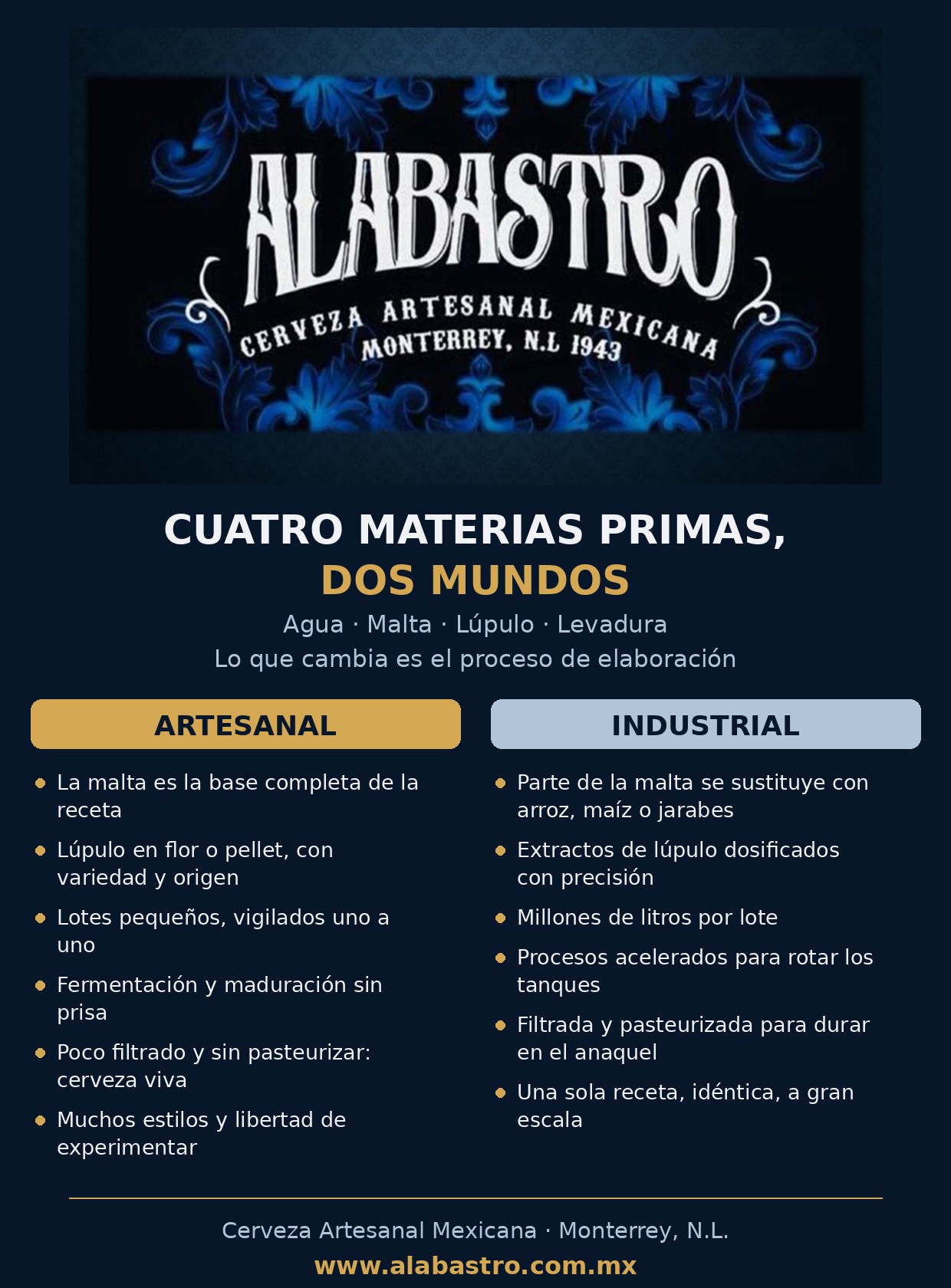
The chemistry, in the end, is the same. What changes is the scale, the control and the way each raw material is worked. At Alabastro we choose the path of the small batch and of raw materials with a name of their own — and you can taste it in the glass.
Which side are you on: craft or industrial? Tell us in the comments.